
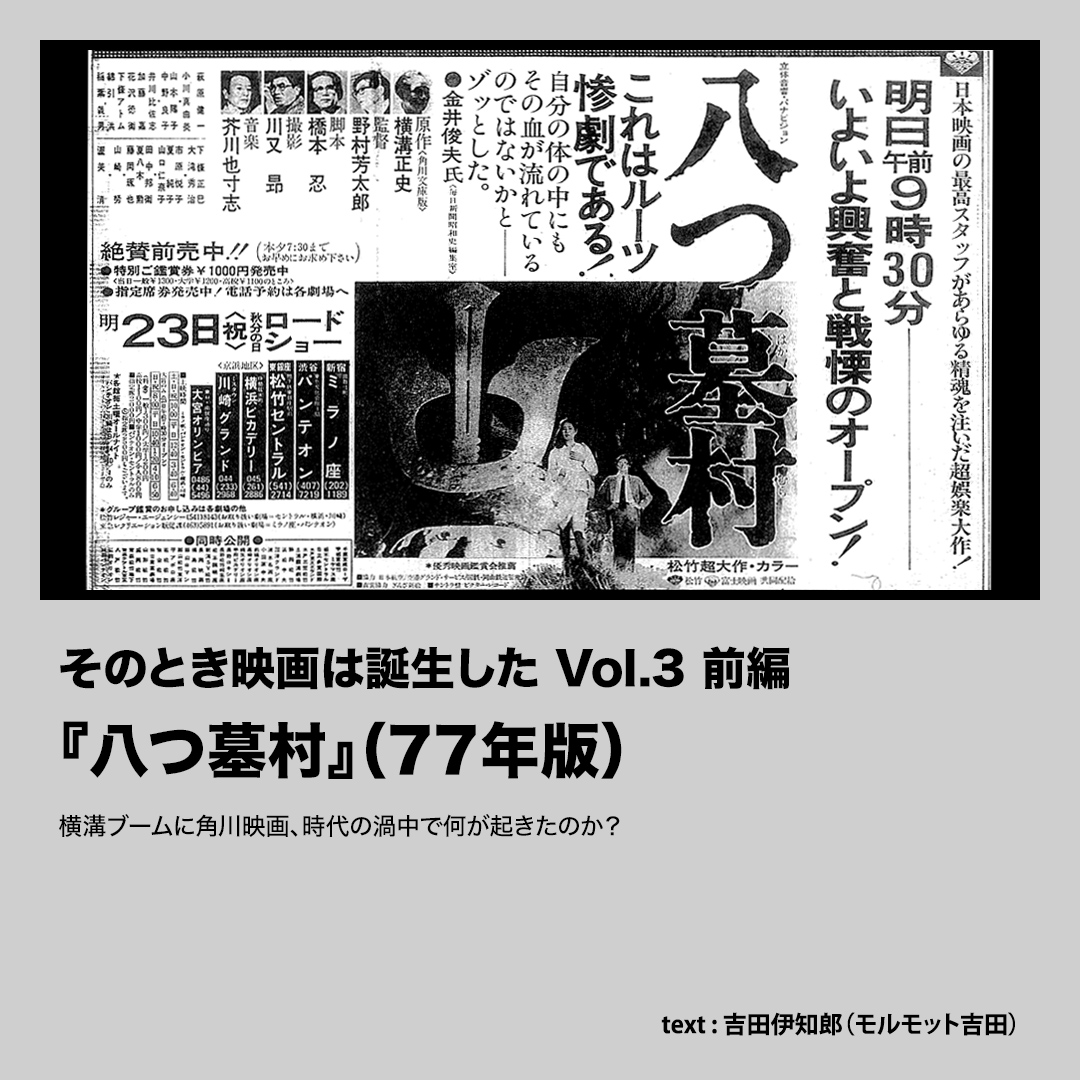
*Source (newspaper advertisement): Author's collection
``Yatsu Tomb Village'' (1977 edition) What happened in the midst of the Yokomizo boom and Kadokawa films? [That's when movies were born Vol.3 Part 1]


Why was "The Inugami Family" made into a movie?
On October 27, 1975, at 11:58 a.m., Kadokawa Shoten president Genyoshi Kadokawa passed away at the age of 58.
Haruki, the eldest son, had been on a 47-day journey from June 20th to August 5th that year aboard the ancient ship Yayogo, an estimated reconstruction of the ship, to elucidate the route to Yamataikoku, travelling from the Korean Peninsula to Hakata. On August 7th, two days after Haruki's return to port, Minamoto Yoshi's health, which had been poor for some time, worsened and he was hospitalized. He spent nearly three months in bed thereafter, and on October 9th, which would have been Minamoto Yoshi's 58th birthday, Haruki, his younger brother Tsunehiko, and his older sister Henmi Jun all came together to celebrate. However, by the end of the same month, his consciousness became cloudy, and his last visit was on the 25th by Matsumoto Seicho and Inoue Yasushi, who passed away the day after. A company funeral was held at Tsukiji Honganji Temple on November 5th. Haruki was the chief mourner, and Seicho was the funeral committee chairman.
The next day, Haruki was promoted from his position as editor-in-chief to president and representative director, and Tsunehiko, who had been head of sales, was promoted to senior managing director. Haruki's appointment as president was announced at the Kadokawa Three Prizes presentation ceremony held at the Tokyo Prince Hotel on December 12th. The Wild Book was brought into the hotel garden, and the grand party surprised the guests and left an impression of a new era for Kadokawa Shoten. It also heralded the beginning of Kadokawa films.
Less than a month The Day After, on January 8, 1976, Haruki established Kadokawa Haruki Corporation, a company dedicated to producing tie-ups for movies, television, records, comics, etc. He then decided to produce a new Yokomizo film to replace "The Village of the Eight Graves," in preparation for the "Second Yokomizo Seishi Fair" scheduled for the fall of that year.
Haruki went directly to Matsuoka Isao, who was Toho's vice president, and told him right then and there that he wanted to do "The Inugami Family." Matsuoka replied that it would be available for the autumn Japanese film lineup. However, the early screening would be at the Hibiya Theater, but the general release would be a double feature with Toho's production "Mother on the Cliff" (1976). Haruki, who was unfamiliar with the movie business, was not yet aware that this would give Toho an advantage in terms of dividing up the profits. At this point, Shochiku's "The Village of the Eight Graves" was scheduled for release in the autumn of 1976, and Haruki's prayer was to pit the film against another film based on Yokomizo's novel and win.
It is said that Haruki's choice of "The Inugami Family" as the first Kadokawa film was a shrewd move. It is certainly one of Yokomizo's masterpieces, which was also made into a film in Kataoka Chiezo's Kindaichi series ("The Inugami Family Mystery: The Devil Dances"). However, if you are a fan of the original work, you would probably want to make films of "Gokumon Island," "The Devil's Ball Song," or "The Devil Comes and Plays the Flute" first, after "Honjin Murder Case" and "The Village of Eight Graves." Why did it have to be "The Inugami Family"?
There are various theories as to why, and Haruki himself has stated some of them. He once said that stories about family problems and parent-child relationships are popular with Japanese people, and once said that it was because of the success of Toyoko Yamazaki's "The Splendid Clan." Haruki also wrote that he was impressed by Joseph L. Mankiewicz's "Sleuth" (1972), and that he chose "The Inugami Family" because of the influence of that film and "Murder on the Orient Express."
--I would like to pose a hypothesis here. How many of Yokomizo's works were actually suitable for film adaptation during this period?
As mentioned above, there is information that Shochiku held the film rights to quite a few of Yokomizo's works in addition to "The Village of the Eight Graves." In terms of major works, it is possible that Shochiku held the rights to "Gokumon Island" and "The Devil Comes, the Flute Plays" for two years from 1975. In fact, in 1977, Toho added these two films to their lineup. If my hypothesis is correct, Toho acquired the film rights as soon as Shochiku's two-year rights expired.
And while "Gokumon Island" was immediately made into a film by Toho, production of "The Devil Comes and Plays the Flute" was shelved and made into a film by Toei two years later. If you consider that the rights were transferred from Shochiku to Toho to Toei every two years, this time lag is not unnatural. If we follow this hypothesis, the films made during the Yokomizo boom in the late 1970s were quite limited in their choice of works. In other words, "The Inugami Family" was probably one of the few films that could have been made into a film by a film company other than Shochiku at that time.
As mentioned above, on December 4, 1975, Haruki was in negotiations with Shochiku to form a partnership for The Village of the Eight Graves. However, on January 8 of the following year, when Kadokawa Haruki Corporation was established, talks of The Village of the Eight Graves disappeared. In other words, we can say that the talks of the partnership were completely cancelled within the space of a month. In fact, the creative notes written by Nagata Norio, who wrote the first draft of The Inugami Family's screenplay, date back to January 1976, so it is believed that the request for the script was made around this time. With The Village of the Eight Graves separated from Kadokawa Pictures and The Inugami Family being planned as a new project, the situation surrounding Yokomizo's films underwent a major transformation.
Kadokawa Pictures debuts
On May 24, 1976, Kadokawa Haruki Corporation announced the production of a film at the Tokyo Prince Hotel. Going beyond the scale of their previous tie-up of publishing and film, they decided to get Toho, Toei, and ATG involved and make three films at the same time. These were "A Glaring Day" directed by Kinji Fukasaku, "The Blade of Oedipus" directed by Toru Murakawa, and "The Inugami Family" directed by Kon Ichikawa and based on a novel by Seishi Yokomizo.
"Someday the Glittering Day" was a joint production between Kadokawa and Toei, based on "The True Story of the Communist Party," which Toei had planned to produce, and starred Takuzo Kawatani. Filming wrapped up in late August, and was scheduled for release in the spring of 1977 (later canceled). In later years, the title was used for the action film "Someday the Glittering Day" (1992), directed by Fukasaku, but the content is completely different.
The film "Oedipus no Yaiba" made with ATG stars Shiho Fujimura, Michiko Saga, Jin Nakayama, Akira Kawaguchi, and Yusaku Matsuda. Trailers were shot in the south of France, and filming was announced to begin in early December, be completed in late December, and be released in the spring of 1977. However, like "Itsuka Gira Gira Suru Hi," it was later cancelled (though later it was remade into a film with a new staff). It was announced that Kadokawa would cover the entire production costs for these two films.
The film "The Inugami Family", which will be distributed by Toho, was produced by Ichikawa Kiichi of Toho's subsidiary Geiensha, who was introduced to Haruki by Haruki's old friend Hara Masato, the managing director of Nippon Herald. Kiichi had just recommended Ichikawa Kon as director, as he had just made a film adaptation of Natsume Soseki's novel "I Am a Cat" (1975), and it is unclear whether this was intended as a dog after a cat, but he recommended Ichikawa Kon as director. The production cost was 220 million yen. With Kadokawa Shoten as a guarantee, Kadokawa Haruki Jimusho received a bank loan of 150 million yen, and Toho invested 70 million yen. It was also announced at this meeting that Ishizaka Koji would play the role of Kindaichi Kosuke.
In conclusion, Kadokawa Pictures, which announced its spectacular start, only completed "The Inugami Family" out of the three films announced, but the fact that it was announced simultaneously by the young president of a mid-sized publishing company, who was a complete novice in film production, and that producers from Toho, Toei, and ATG were in attendance, was enough to publicize the start of Kadokawa Pictures. In the first place, the very fact that rival companies were in attendance was a violation of industry convention, and Haruki was warned by people in the film industry as follows:
"Putting them together was unthinkable in the conventional wisdom of the film industry... But when I spoke to Ichikawa Kiichi (Toho), Kusakabe Goro (Toei), and Kuzui Kinshiro (ATG) afterwards, they said it didn't bother them that much and it didn't really bother them. It seems that even the most common sense things don't go over well in the film industry." (Movie Magazine No. 7)
In other words, the film companies that agree with Haruki's idea of "common sense" were all at the press conference. The absence of Shochiku at the meeting was a hot topic in industry magazines, with inside information leaking out early on, with one stating, "According to one theory, Kadokawa had approached Shochiku, but there are also rumors that the deal fell through because Shochiku did not promise to be able to make the film in time for the Yokomizo Seishi fair in October" (Movie Times, May 1976).
On June 22nd, a separate production announcement for "The Inugami Family" was held at the Akasaka Prince Hotel, where the main cast, including Ishizaka Koji, Takamine Mieko, and Shimada Yoko, gathered in their costumes from the film. Yokomizo also showed up at the event, and commented, "This is the first time we've seen Kindaichi in traditional Japanese clothing" (Sports Nippon, June 23rd, 1976), and was pleased to see Ishizaka = Kindaichi dressed exactly like in the original, as Kindaichi's previous style had been quite different from that of the original. He then made the reporters laugh by saying, "When I read the script, it was so gory that it was scary. I never wrote anything that scary" (ibid.).
The film started shooting on June 30th at Lake Aoki in Omachi, Nagano Prefecture, and continued to generate buzz as it went on. On July 23rd, Yokomizo also participated in the filming, which took place at an inn in Mochizuki-cho, Kitasaku-gun. He appeared as the owner of the Nasu Hotel, and had a conversation with Kindaichi. In an interview with the Shinano Mainichi Shimbun, Yokomizo said, "I'm looking forward to seeing how it turns out. However, I'm a writer. I'd like this to be my first and last film appearance. This is the second time this work has been made into a film, following the one starring Kataoka Chiezo twenty-odd years ago. That's why I'm happy that the work has a long life." However, this was not the first and last time Yokomizo would appear in a film, and he would be brought out to appear in the trailers and main feature films as if it were a regular event.
While the filming of "The Inugami Family" was progressing smoothly, a sense of crisis was building up around Shochiku's "The Village of Eight Graves." Although the film was planned in 1971 and preparations had begun in 1975, budgetary issues had not been resolved and there was still no prospect of filming.
Continued in Part 2
*References will be listed in the second part.
(Part 1, end)
Text: Ichiro Yoshida (guinea pig Yoshida)
Born in 1978. Movie critic. He has written for ``Eiga Hiho'', ``Kinema Junpo'', ``Eiga Geijutsu'', ``Scenario'', etc. His books include ``Introduction to film criticism! ” (Yosensha), co-authored with “Film director Takeshi Kitano. ” (Film Art Company) and others
Follow official SNS


