
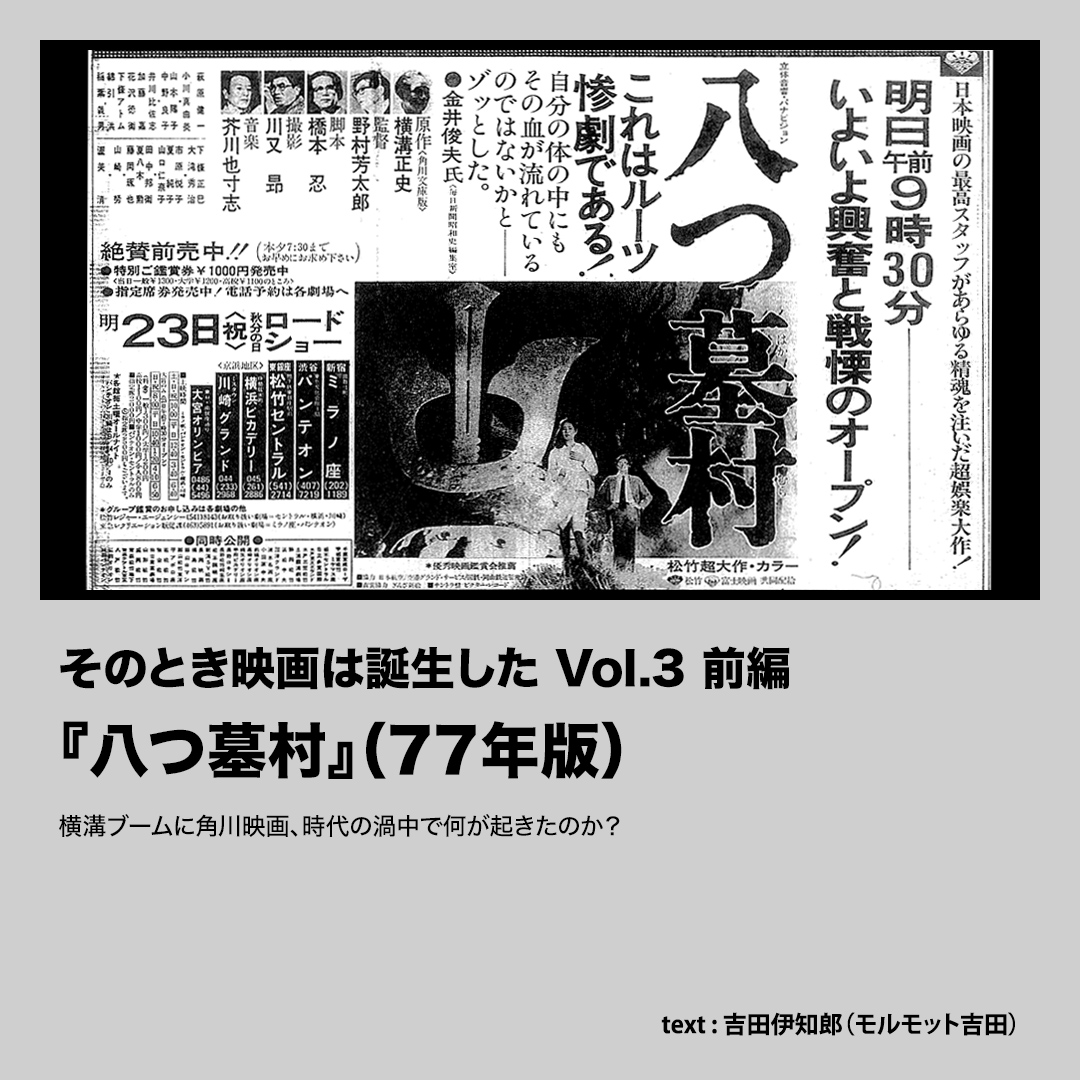
*Source (newspaper advertisement): Author's collection
``Yatsu Tomb Village'' (1977 edition) What happened in the midst of the Yokomizo boom and Kadokawa films? [That's when movies were born Vol.3 Part 1]


The visual history of "The Village of Eight Graves"
When you hear Yokomizo Seishi and Kindaichi Kosuke, the titles that come to mind are probably "The Village of the Eight Graves" and "The Inugami Family." Of course, Yokomizo left behind many other long, medium-length, and short stories, but as of January 2024, "The Village of the Eight Graves" has been made into three movies and eleven TV dramas, and "The Village of the Eight Graves" has been made into three movies and ten TV dramas, proving how well-known they are. It is still fresh in our memory that in April 2023, "The Inugami Family" was broadcast as a two-part drama on NHK, marking its 11th film adaptation.
Written between 1949 and 1951, The Village of the Eight Graves had already been made into a film and two TV dramas before the 1977 Shochiku version. The first film adaptation was in 1951, when the book was first published, as the third film in Toei's Kindaichi series, in which Kataoka Chiezo played Kindaichi. Chiezo's version of The Village of the Eight Graves (51) is one in the series that began with The Three-Fingered Man (47), a film adaptation of Honjin Murder Case, in which Kindaichi first appeared. The atmosphere of the film adaptation at the time can also be gleaned from a letter that Edogawa Ranpo wrote to Yokomizo Seishi (held at the Setagaya Literary Museum). Let me quote it below.
"The other day I met the Kyoto studio director and Hisa-kun at the preview of Gokumon Island, and heard that they had brought a large envelope with them, but it was not much, and that they should make up for it when they do Yatsuhakamura, and it seems that they are thinking the same. I think it would be fine to ask for twice as much for Yatsuhaka as for Gokumon, and if we add in the shortfall for Gokumon on top of that, we should be able to offer at least 40. (Omitted) Anyway, it's a big hit, and I hear it's the highest grossing film of the second half of this year. And since it's been released twice, it must be making a lot of money. As a story it's different from the original, but it's a little more interesting than Three Fingers. I think it's one of the best of the traditional detective stories."
The Setagaya Literary Museum's "Letters from Edogawa Ranpo to Yokomizo Seishi" estimates that the letter was sent on December 8, 1950, but the contents of the letter are that Ranpo informed Yokomizo that he had seen "Gokumon Island" (49), the second film in the Chiezo Kindaichi series (the original is pronounced "gokumontou", but the film is pronounced "gokumonjima"). As the text says "twice," "Gokumon Island" was a two-part film, and since the second part, "Gokumon Island Kaimei-hen," was released on December 5, 1949, it is likely that Ranpo wrote the letter after seeing a preview of the second part (which was often held the day before or two days before the release at the time). In that case, the letter is likely to have been sent on December 8, 1949.
Putting the criticism aside, the contents of the letter show that the novel is more interesting than his previous work, "The Three-Fingered Man," and that even Ranpo, whose own works had been made into films before the war, praised it, calling it "one of the best of the traditional detective stories." Ranpo also advised that since "Gokumon Island" had been a huge hit, it would be okay to charge 400,000 yen for the original story fee when "The Village of Eight Graves" was next made into a film. As an aside, seven years The Day After, the original story fee for "Vampire Moth" (1956), which was made into a film by Toho, was 700,000 yen, and for "The Devil's Ball Song" (1977), which was made into a film by director Ichikawa Kon during the height of the Yokomizo boom, 2 million yen was paid.
As Ranpo wrote, "It's different from the original," in Chiezo's version, Kindaichi is not in the haori and hakama of the original, but in a dashing suit, he even carries a gun, and the criminal is different from the original in every episode. Fans of the original will find this laughable, but the strength of Chiezo's version is that it was made in the same era as the original, so the mood can be felt just by showing the scenery and buildings as they are. Also, if you can accept that Kindaichi is played by a glamorous star, it's surprisingly enjoyable.
Of the six films in Chiezo's Kindaichi series, only three are publicly available: "The Three-Fingered Man," "Gokumon Island: Compilation," and "The Three-Headed Tower" (56). As of now, it is impossible to see "The Village of Eight Graves" or "The Mystery of the Inugami Family: The Devil Dances" (54), the first film adaptation of "The Inugami Family," so the only way to gauge their contents is from the scripts used in the filming. In 2023, a 16mm film of "The Devil Comes and Plays the Flute," one of Chiezo's Kindaichi series, was put up for auction on an auction site and sold for 730,000 yen. It is unclear what became of this film, but it is possible that the lost film mentioned above could be unexpectedly discovered by following this route.
Now, if you actually read Chiezo's version of the script for The Village of Eight Graves, you will be surprised by the unexpected turn of events in which Kindaichi returns to the village of eight graves disguised as Tatsumi, but if you consider that Chiezo starred in the Kindaichi series in parallel with the Tarao Bannai series, in which he changes his character seven times throughout the film, you will naturally understand the position of this series. Rather, what is interesting is that although the plot of the original work is followed, there are bold changes here and there, such as the number of villagers killed by Tajimi Yozo in the original work being halved to 16 in the film, and the number of twin old women being reduced to one. The biggest change is the unexpected turn of events in which the culprit is an original character from the film that does not appear in the original work.
Whether or not this is acceptable will depend on whether you think a faithful film adaptation of the original work is the best, but since the original work is told in the first person by Tatsumi, filming "The Village of Eight Graves" requires some ingenuity. In previous film adaptations, Kindaichi has sometimes played a supporting role, as in the original work, and sometimes the story has been arranged to make Kindaichi the main character. In that respect, if Kindaichi disguises himself as Tatsumi, as in Chiezo's version, it kills two birds with one stone. However, no matter how you look at it, this is an impossible method for anyone other than Chiezo, who is Kindaichi in the Tarao Bannai style.
The next time "The Village of the Eight Graves" was made into a film was 18 years later, in 1969. It was broadcast in the "Mysterious Romance Theatre" slot on NET (now TV Asahi), with a young Tamura Masakazu playing Tatsumi, and Kanauchi Yoshio playing Kindaichi, who was Tatsumi's senior doctor. Moreover, since it was broadcast in a one-hour slot, the main story was only 48 minutes long. You might wonder how they could summarize such a lengthy original story in just under an hour, but when you watch a rebroadcast in recent years, it is one of the most complete versions of "The Village of the Eight Graves." Although important characters such as the twin old women and the village doctor were cut, and the number of murders of 32 villagers was reduced to eight, Tatsuo Nogami's adaptation made it stand out, making it a work that didn't seem like a flaw. Two years later, in 1971, it was made into a five-episode drama series on NHK, which recorded high viewer ratings of 21% for the first episode and 23.4% for the final episode, but Kindaichi did not appear in this one.
If we were to rank the film adaptations of "The Village of the Eight Graves" since Shochiku's 1977 version in order of production by the actor who played Kindaichi, we would get Furuya Ikko in 1978 and 1991, Kataoka Tsurutarou in 1995, Toyokawa Etsushi in 1996, Inagaki Goro in 2004, and Yoshioka Hidetaka in 2019.At this rate, it is certain that an 11th film adaptation will be realized in the not-too-distant future.
Yokomizo's films: a 14-year Intolerance
Follow official SNS


