
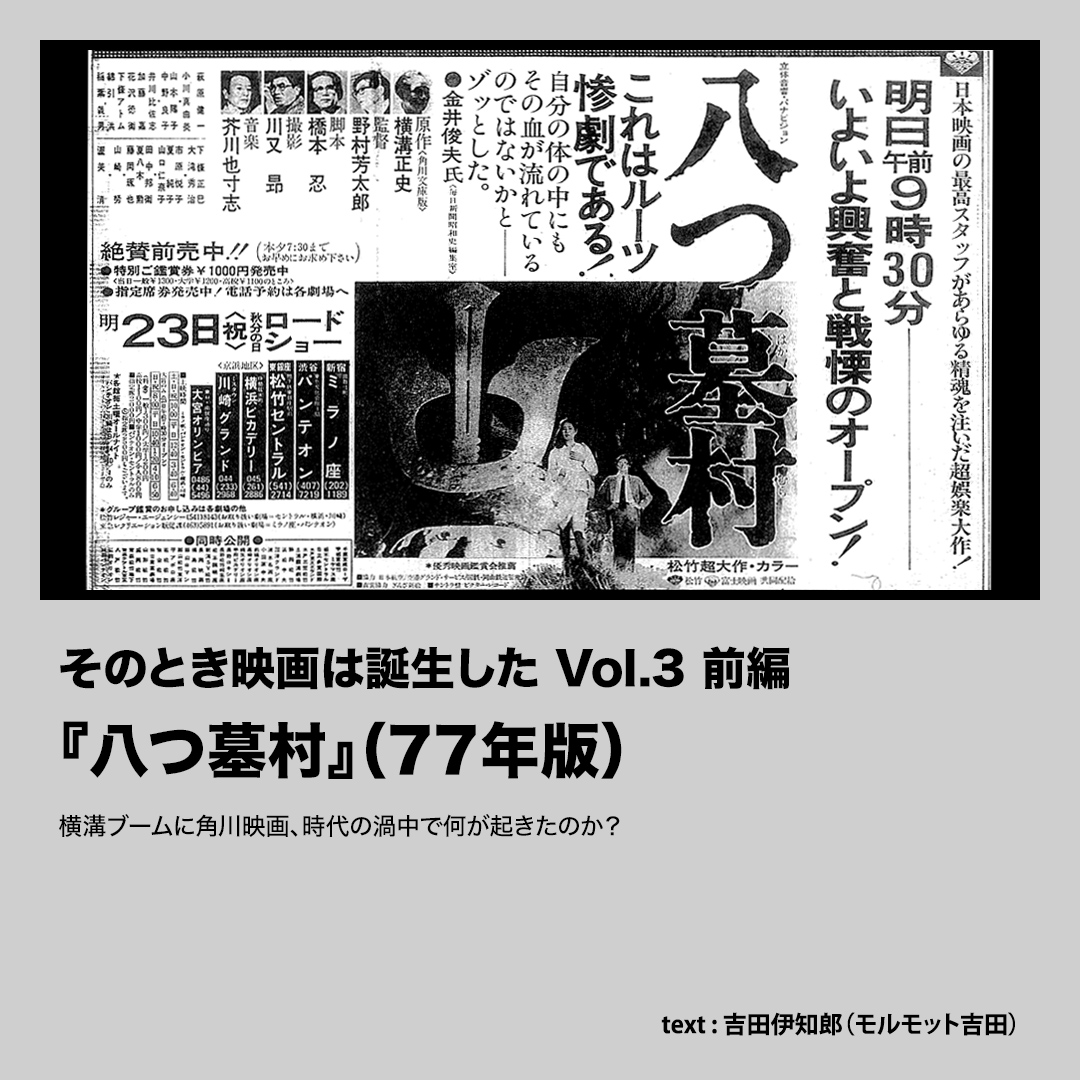
*Source (newspaper advertisement): Author's collection
``Yatsu Tomb Village'' (1977 edition) What happened in the midst of the Yokomizo boom and Kadokawa films? [That's when movies were born Vol.3 Part 1]


Yokomizo's films: a 14-year Intolerance
The six-film Kindaichi series, produced by Kataoka Chiezo between 1947 and 1956, generated stable profits, and during this time film companies rushed to adapt Kindaichi stories into film. Daiei made Oka Joji's Kindaichi for "The Strange Tale of Poison Snake Island: The Queen Bee" (52), and Toho did the same, showing Kindaichi's influence in film. In 1977, at the height of the Yokomizo boom, Weekly Heibon collected comments from the actors who had played Kindaichi, who were still alive at the time, so we will introduce some of them here.
Kawazu Seizaburo of "Ghost Man" (1954, Toho) - "The company (Toho) was in turmoil at the time, the director was changed at short notice, and we only had a week to shoot the film, but the results were still good. That was the era."
Ryo Ikebe from "Vampire Moth" (1956, Toho) - "It was so long ago that I've forgotten! I'm sure I wore my own Burberry coat. It wasn't a film I was really into."
Takakura Ken in "The Devil's Ballad" (1961, Toei) - "When I think back, I was extremely busy at the time, playing one role after another."
The change in director that Kawazu is referring to is likely referring to the fact that "Ghost Man" was originally directed by Makino Masahiro. In common, they barely even remember that they played Kindaichi Kosuke. Yokomizo's films from this era were merely one of the program pictures that were shown every week or two. It is said that the script for Takakura Ken's "The Devil's Ballad" was written without reading the original work, so this is the height of shoddy production. It was an era when films made in this way still drew audiences, so there's no point in saying that the character of Kindaichi is different from the original, or that the culprit is different.
However, at the same time as the film industry went into decline, in the world of mystery novels, Seicho Matsumoto's socially conscious mystery novels rose to prominence, and Yokomizo's old-fashioned full-scale detective novels became less prominent. In the film world, too, after Toei's "The Demon's Ball Song," Yokomizo's films disappeared from the big screen for 14 years, and the number of films based on Seicho Matsumoto's novels increased.
However, even though he may have been forgotten in the world of film, Yokomizo was still alive and well in the world of television and manga. Although Kindaichi does not appear in Nippon Television's "Tuesday Woman" series, "The Inugami Family" was turned into "Blue Beasts" (1970), "The Demon's Ball Song" was turned into "Female Friends" (1971), and "The Three-Headed Tower" was turned into "Cousins" (1972) under the new titles. Yokomizo's works were constantly being adapted into films, including the period drama "Ningyo Sasshichi Torimonochō." Meanwhile, in 1968, the comic book version of "The Village of the Eight Graves," illustrated by Kagemaru Jōya, began serialization in "Weekly Shōnen Magazine," and depicted a unique worldview. This not only paved the way for subsequent comic book adaptations by Tsunoda Jiro and JET, but also became one of the reasons why Kadokawa Haruki included Yokomizo's works in his Kadokawa Bunko collection in later years.
During the 14 years when Intolerance Yokomizo films were made, it was not as if no one had thought of adapting them into films. In 1969, Toei Kyoto Studio was preparing "Inferno" as one of the films in the abnormal love genre, directed by Ishii Teruo, but when the project fell through, they quickly decided to produce "The Complete Works of Edogawa Ranpo: Fearful Deformed Men" (1969), based on a work by Edogawa Ranpo. According to screenwriter Kakefuda Masahiro, at the time of planning, Yokomizo Seishi's work was also on the list. Kakefuda, a Yokomizo fan, was apparently aiming for "The Village of the Eight Graves" or "Gokumon Island," but Ishii, who liked Ranpo, pushed for "Fearful Deformed Men," which mixed Ranpo's works such as "The Demon of the Lonely Island," "The Strange Tale of Panorama Island," "The Wanderer in the Attic," and "Psychological Test." Nevertheless, film critic Sato Shigeomi, who sensed the lingering scent of Yokomizo in this film, pointed out in his review at the time of its release that "the image of an old family home is incorporated from 'The Village of the Eight Graves'" (Eiga Hyoron, May 1970).
Two years later, in 1971, two filmmakers discussed the possibility of adapting Yokomizo's work into a film. These were screenwriter Shinobu Hashimoto and Shochiku director Yoshitaro Nomura. In the same year that the aforementioned NHK drama series was broadcast, they were considering a new project and Yokomizo caught their eye. They also read The Village of the Eight Graves at that time, but the project did not progress at this point.
Also, in 1973, "The Devil's Ballad" was in Shochiku's lineup. It was announced that the director would be Junzo Mizukawa, and that the cast would include Yoshiko Kayama, Koji Moritsugu, Yasunori Irikawa, and Kazuko Iwasaki, but the project was cancelled just before it could go ahead. Kobayashi Kyuzo, who planned the project, joined Shochiku's Ofuna Studio as an assistant director, and later worked in various roles such as planning staff and producer. He was also a mystery writer, and one of his representative works was "August Without the Emperor," which was also made into a film. As he was an authority on mystery films, Kobayashi was also disappointed when the project was cancelled. As an aside, Kobayashi later wrote a book about the inside story of the film's production, "The Devil's Ballad Murder Case," which was made into a TV drama in 1987.
Although there were some projects that came close to being realized, a period lasted for 14 years in which the world Yokomizo created was no longer needed on film.
Detective Columbo vs. Kosuke Kindaichi
It was Columbo that indirectly brought back the character Kindaichi Kosuke, who had disappeared from the big screen. Around October 1974, film critic Ishigami Mitoshi visited Yokomizo and they had a discussion on the TV movie Columbo, which was a hot topic at the time, and Kindaichi Kosuke. The idea was to have Yokomizo talk about Columbo, as Columbo, with his unkempt hair, wrinkled coat, and lack of good looks, resembled Kindaichi. Ishigami was a film critic well versed in horror and mystery films, and had written the novelization of Columbo, but he also worked as a commercial planner for Dentsu.
"My main job was advertising, so I was sensitive to changes in the media, and I introduced and discussed a lot of things... this is what made me different from other film critics. To be honest, I think I was a pretty strange critic." (Ishigami Mitoshi Scrapbook: Japanese Film Mystery Theatre)
Ishigami, who was recognized as a film critic who stood out from his contemporaries, learned while writing a column for the Tokyo Shimbun newspaper that Yokomizo Ryoichi, a reporter in the culture department, was Masashi's eldest son. Ryoichi, seeing Ishigami's vast knowledge of detective novels, asked him to talk to him, since hardly anyone comes to see his father these days. However, Ishigami couldn't bring himself to visit without a reason, so he decided to visit Yokomizo under the pretext of an interview for the publication of the novelization of Columbo. In the interview, not only were there similarities between Columbo and Kindaichi, but there were also some thought-provoking remarks from the perspective of "adapting detective novels into film," and among them, Ishigami brought up the topic of future film adaptations of Yokomizo's works.
Ishigami: There was a movie about Kindaichi Kosuke in the past, but have there been any talks of a film adaptation recently?
Yokomizo: No, I don't.
Ishigami: This is just a dream, but if I were a film director, I would definitely want to make "Gokumon Island" into a movie (laughs).
Yokomizo: Oh, I see. (Laughs)
Ishigami: In the previous version, Kataoka Chiezo played Kindaichi Kosuke and appeared with a gun in his hand (laughs)...but I think an actor like Columbo would have been better suited to that.
("Columbo (11) / Farewell Wine" Futami Shobo, "New Edition Yokomizo Seishi Complete Works (18) Detective Novel Fairy Tales" Kodansha, "The World of Yokomizo Seishi" Tokuma Shoten)
The reason why Ishigami particularly emphasizes the Colombo = Kindaichi theory is that at the time, whenever an overseas hit movie was released, a Japanese version was immediately planned. Just as the Bruce Lee and panic movie booms spread to Japanese movies, it is not surprising that a producer would try to make a Japanese version to capitalize on Colombo's popularity. Ishigami emphasizes that Kindaichi Kosuke was at the forefront of such efforts. There is no need to overestimate the influence of Ishigami's statement, but it is worth noting that six months after the interview, work began on the film adaptations of "Honjin Murder Case" and "The Village of the Eight Graves."
A few years later, in the commentary at the end of "Sengoku Jieitai" (Kadokawa Bunko), Ishigami wrote about his anticipation for the film adaptation, and considering the fact that this played a part in realizing the film "Sengoku Jieitai" (1979), Ishigami's later assessment of himself: "I feel that, with Columbo's help, I was able to help, even if just a little, in the visual restoration of Yokomizo's work" (FLIX DELUXE, Winter 1994 issue) is probably quite appropriate.
It should also be noted that the month after Ishigami and Yokomizo's conversation, a spectacularly extravagant mystery blockbuster was released in the US and the UK: Murder on the Orient Express(1974), based on an original story by Agatha Christie. This big-budget mystery blockbuster, featuring an all-star cast, was released in Japan in May 1975, and the format was later passed on to Kadokawa Pictures' first film, The Inugami Family.
Hashimoto Productions and "Castle of Sand"
Follow official SNS


