
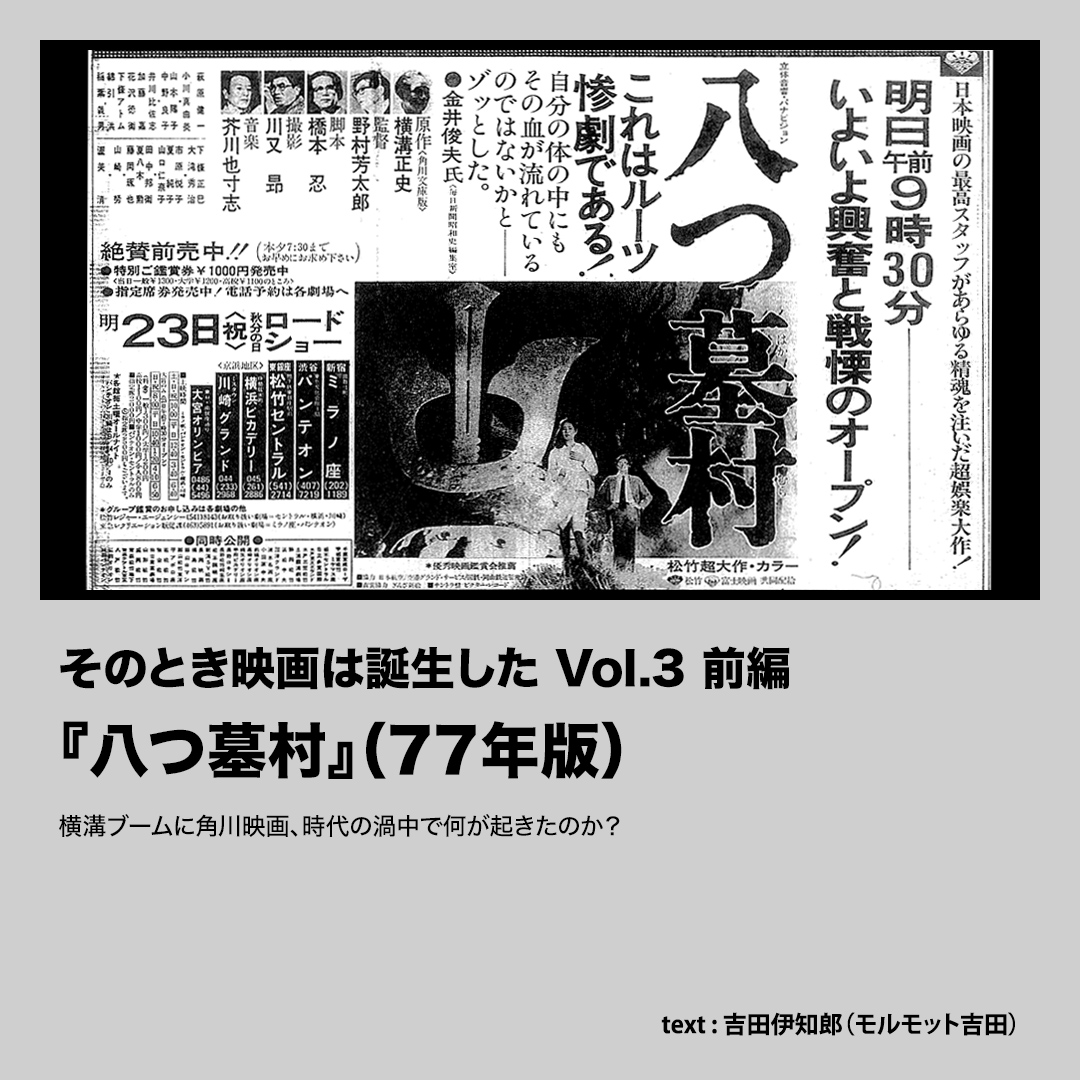
*Source (newspaper advertisement): Author's collection
``Yatsu Tomb Village'' (1977 edition) What happened in the midst of the Yokomizo boom and Kadokawa films? [That's when movies were born Vol.3 Part 1]


Hashimoto Productions and "Castle of Sand"
"The Village of the Eight Graves," which was put forward as a possible project in 1971 by Nomura Yoshitaro and others, did not begin to move forward in any concrete way until the release of "Castle of Sand" (1974), based on a novel by Matsumoto Seicho and released on October 19, 1974, which became a huge hit.
It took 14 years to bring "Castle of Sand" to fruition. Shochiku planned to continue adapting Seicho's works with the same team of Nomura Yoshitaro and Hashimoto Shinobu, who had successfully adapted "The Stakeout" (58), based on a Seicho novel, and decided to adapt the work, which was serialized in the Yomiuri Shimbun newspaper. Yamada Yoji, who was still an assistant director at the time, also helped with the script, completing a strikingly adapted screenplay that reconstructed the complex original work into a cinematic one. With some of the cast, including Kato Yoshi, already decided on, preparations for filming progressed smoothly, and the cherry blossom scenes had already begun shooting.
However, due to the strong opposition of Shochiku president Shiro Kido, the film adaptation was shelved. There are various theories as to why, but The Day After that, every two years when the film rights were renewed, talk of a film adaptation would come and go, and it became a phantom project.
This situation changed in 1973, when Hashimoto Productions was founded with the aim of producing films and television programs centered around Hashimoto. Participants included eight distinguished individuals, including film directors Nomura Yoshitaro (Shochiku) and Moritani Shiro (Toho), and television producer Oyama Katsumi of TBS. However, it was not launched with much fanfare, but rather quietly started as a planning study group. Until the first production, "Castle of Sand," was released, the existence of this group of extraordinary talents was hardly known. What they aimed for was a project that could not be realized within a film company or television station - in other words, a work that would require a lot of time and money. Nomura talks about his feelings at the time.
"I feel like we are gradually entering an age where directors cannot survive by simply making things that are planned, and they must also think carefully about what kind of movie they want to make. (Omitted) In this age where there is such an abundance of television and other images, if a movie doesn't have the volume or value to justify the price of admission, people won't pay the admission fee to see it." (NHK Life Reader (5))
That was the reason why Hashimoto Productions attempted to adapt "Castle of Sand," which had been branded as unproductable by other film companies, and "Mt. Hakkoda," which was shot on location in the area. However, the founding of Hashimoto Productions did not mean that "Castle of Sand" was realized all at once. The biggest problem for an independent production company was securing a theater. No matter how luxurious and excellent a film you make, if there is no theater to show it in, it is difficult to recoup the production costs. It is necessary to partner with a major film distribution company with a distribution chain across the country.
Based on their relationship up until now, Hashimoto Productions approached Shochiku about a partnership, but President Kido still opposed the production. Hashimoto decided that there was no hope for the project at Shochiku, so he took the plan to Toho. Toho's condition was that Nomura be the director. However, in order for Nomura, who has an exclusive contract with Shochiku, to direct at Toho, he needed to get Shochiku to approve the loan or terminate his exclusive contract. Nomura, who has strong producer qualities, felt the stagnation of Japanese movies, and felt that he had reached his limit at Shochiku, saying, "I can't do any more because the works I want to make aren't being realized" (Nomura Yoshitaro, Master of Movies). Then, when Hashimoto Productions approached Shochiku about loaning Nomura, unrest spread within the company. If Nomura, who supports Shochiku's backbone along with Yamada Yoji, were to shoot "Castle of Sand" at Toho, Shochiku would be a laughing stock. At this point, "Castle of Sand" was finally made into a film through a partnership between Shochiku and Hashimoto Productions.
As for the reaction after its release, it will be sufficient to note that it was the third highest grossing Japanese film of the year, won the Mainichi Film Awards Grand Prize, won Best Screenplay, Best Director, Best Music, and the Kinema Junpo Screenplay Award.
Following "Castle of Sand," Hashimoto Productions began work on "Mt. Hakkoda," a project proposed by Nomura Yoshitaro. According to Nomura, after these two films, Hashimoto Productions "actually had a film called 'Mura of the Eight Graves' next, and we thought this would be profitable" (Kurosawa Akira Research Journal No. 8), revealing that although it was not officially announced as part of the lineup, "Mura of the Eight Graves" was planned as Hashimoto Productions' third film. However, after many twists and turns, "Mura of the Eight Graves" was ultimately made as a Shochiku independent production, but there was still a long way to go before that happened.
"The Village of the Eight Graves" was made as a "grave-visiting movie"
Following the huge success of "Castle of Sand," Shochiku began to search for the next project -- in other words, a project that could become "Castle of Sand 2." At the end of 1974, Kobayashi Kyuzo, a member of Shochiku's planning department, was ordered by the head of the film production department to consider Nomura Yoshitaro's next work. Kobayashi felt that Seicho's films had reached their peak with "Castle of Sand," so he insisted that even though it was a mystery suspense film, it needed to take a different direction from Matsumoto Seicho's. He found several original novels that could be adapted into a film and presented them to Nomura. However, he did not receive a favorable response. Nomura was searching for his next project on his own. A casual conversation with Hashimoto Shinobu and Yamada Yoji, who were also present at the film festival awards ceremony in February 1975, became a major guide. Nomura remembers the conversation.
"We were talking about what movies would be big hits at the time, and I had been talking to Mr. Hashimoto about it before, and we had the idea that it would probably be "The Village of the Eight Graves"" (Movie Times, June 1977 issue)
In 1971, the two men had researched the film adaptation of Yokomizo's work and had read "The Village of the Eight Graves." They agreed that this time, with the cooperation of Hashimoto Productions and Shochiku, they would make a film adaptation. Hashimoto's idea that a hit film = "The Village of the Eight Graves" had a unique justification. It was as follows.
"I was inspired by the rush of people returning home for the Obon holiday at Ueno Station. The nostalgia of visiting one's ancestors' graves is something that never changes, no matter the era. In short, I saw that 'The Village of the Eight Graves,' a suspenseful depiction of human nostalgia for graves, had the ingredients to become a hit." (Kinema Junpo, late April 1977 issue)
It may seem a little rough to interpret The Village of the Eight Graves through the keyword "visiting graves," but if we look back at the story depicted in the film, the origin of the film is an incident that occurred during the Eiroku era, when eight defeated warriors, including Amago Yoshitaka, who had been defeated by the Mori clan, drifted into a mountain village and were betrayed and murdered by the villagers. The village's leader went mad and brutally murdered the villagers, so the villagers, fearing a curse, carefully buried the bodies of the eight defeated warriors and built a shrine. As a result, the village eventually came to be called The Village of the Eight Graves. In the modern-day part, Tatsumi decides to return to the village to attend the funeral of his grandfather, who died unexpectedly, and attends the funeral. Indeed, The Village of the Eight Graves is undoubtedly a film that "depicts in a suspenseful way the nostalgia people feel for graves."
In the second draft of the script for "World War III: The Last Day of Tokyo," which was never made into a film, Hashimoto had a situation in which the protagonist goes to his hometown to visit his family graves before the last day in Tokyo. For Hashimoto, the keyword "visiting graves" is a universal Japanese act that will never change, no matter what era it is or what happens.
After four years, Nomura began thinking about "Mura of the Eight Graves" as his next project, and Kobayashi from the planning department also suggested Yokomizo's work. As Kobayashi recalled in "Gen'ei-jo" (May 1976 special issue), Nomura also agreed, saying, "I began to think that there was no other option," and thus Yokomizo's work was reexamined. As a result, the film candidates were narrowed down to three: "Mura of the Eight Graves," "Gokumon Island," and "The Devil Comes and Plays the Flute," and finally "Mura of the Eight Graves" was selected as the first film. However, Kobayashi had concerns. As mentioned above, two years earlier, he had tried to make "The Devil's Ball Song" at Shochiku, but the project was canceled just before it was realized. He was unsure whether the company's upper management would accept "Mura of the Eight Graves," which was also based on a Yokomizo novel. With Kobayashi's eyes on him, Nomura said that if they would not accept it, he would have another company produce it, and showed his intention to negotiate with the executives using the same strategy as for "Castle of Sand."
Thus, planning discussions began, but Shochiku was still unsure as to whether it should give the official go-ahead for the production of The Village of Eight Graves.
The complete story of the 1975 version of "The Village of Eight Graves"
Follow official SNS


