
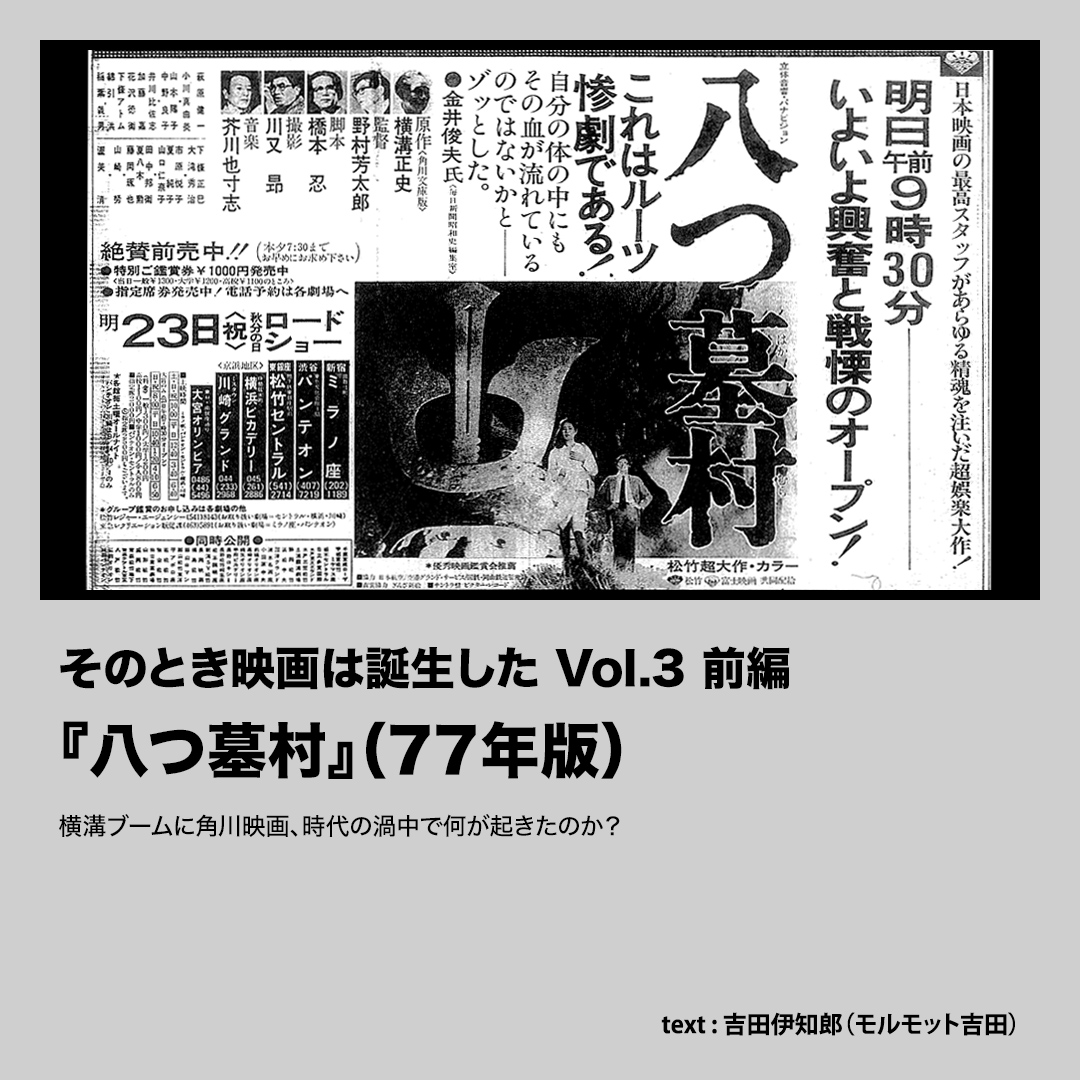
*Source (newspaper advertisement): Author's collection
``Yatsu Tomb Village'' (1977 edition) What happened in the midst of the Yokomizo boom and Kadokawa films? [That's when movies were born Vol.3 Part 1]


The complete story of the 1975 version of "The Village of Eight Graves"
Planning for "Mura of the Eight Graves," which began in February 1975, had already been decided on by Nomura Yoshitaro as director, but the script was to be written by screenwriter Suzuki Takayuki, known for "The Straits of Hunger" (1965), and not by Hashimoto Shinobu, who had originally proposed adapting the film. The circumstances surrounding this are unclear, but at the same time, Hashimoto Productions began production on "Mura of the Eight Graves," and location scouting and actual snow filming began in location scouting in February of that year. It would have been physically impossible for Hashimoto, who had been planning to be present at all of the filming, to write the script for "Mura of the Eight Graves." At this point, it seems that talk of Shochiku and Hashimoto Productions collaborating on "Mura of the Eight Graves" had died down. Hashimoto began writing the script for "Mura of the Eight Graves" in March 1975. Nomura had never worked with Suzuki before, but when the two were discussing the project, Nomura happened to say he wanted to do "Mura of the Eight Graves," and Suzuki also showed interest in adapting the film, which is how the two got started.
The "Yatsuhakamura Proposal" (often written as Yatsuhakamura) dated May 17, 1975, has "Proposal: Nomura Yoshitaro, Suzuki Takayuki" on the cover, and the opening paragraph about the intention of the plan states, "The sense of bewitching beauty that is characteristic of his (Yokomizo Seishi) works may coincide with the occult boom at the time, but the human themes that run through his works, the rustic background of the works, and the fast-paced development of the story are likely to have been received with a fresh feeling. It is also interesting that each character has a unique personality." It goes on to say, "There are some issues with the script composition, but this story is faithful to the original. For example, the time period is the 1940s, just like the original." The synopsis that follows is also almost faithful to the original. I was unable to find the script written by Suzuki, but the proposal gives a sense of the direction of Suzuki's adaptation, so I will introduce some of the distinctive parts.
The story begins with the village's legends and past events, then moves to the present day (1945-1959). The aftereffects of the defeat in the war are also felt in Yatsuhakamura. The Tajimi family is faced with a problem of succession, and the story begins with the elder twins Kotake and Koume asking lawyer Suwa, who is from the same village and has an office on Yokohama's Kaigan-dori, to find Tsuruko and her son Tatsumi, who left the village at a young age. Tatsumi's cousin Satomura Shintaro is the rightful heir, but Kotake and Koume dislike Shintaro, and that is why they want to find Tatsumi.
The synopsis details the relationship between Shintaro and Miyako, suggesting that their relationship will be emphasized at the script stage. During the war, Shintaro, who was the object of the village's hopes, was an army major working at the General Staff. Miyako met Shintaro through her husband and developed a deep relationship with him, continuing their relationship even after her husband's death. After the war, when Shintaro is demobilized and returns to the village, Miyako follows him back from Tokyo. Carrying the Notorious of being a war veteran, Shintaro leads a suffocating life, a stark contrast to his wartime days, and Miyako wants to help him get back on his feet, but he does not reciprocate her love.
During this period, Suzuki worked on Toyoko Yamazaki's works such as the TV drama "Hanareinaru Ichizoku" (The Splendid Clan), but in film, he was more interested in young people at the mercy of war, such as depicting the war from the perspective of ordinary people in "Navy Boy Special Soldier" (1972). For Suzuki, born in 1929, war was a life-sized perspective. For this reason, it is not surprising that he tried to adapt this work with Shintaro, who lost his humanity because of the war, as the central character. In fact, from the fact that at the end of the film, a development that was not in the original novel, in which Kodake Koume and Shintaro are reconciled thanks to Tatsuya's efforts, we can begin to get a vague idea of what Suzuki was trying to portray in "Mura of the Eight Graves."
Another thing worth noting is that although Kiyoshi Atsumi had not yet been cast as Kindaichi Kosuke at this point, Suzuki had a special relationship with him. Suzuki became close to Atsumi after writing the script for "Okashina Yatsu" (1963), in which Atsumi played San'yutei Kasho, and the two began to have A Very Private Affair relationship, even accompanying Atsumi on a commercial shoot in Africa. In 1972, Suzuki also wrote the script for "Ah, A Voiceless Friend" (1972), which was planned by Atsumi. This is the story of a former Japanese soldier who is the only surviving member of his unit and travels around delivering the wills of 12 war comrades, and once again depicts the shadow of the war that continues into the postwar period.
This is just my imagination, but I think Suzuki was trying to portray Kindaichi as a war veteran in "The Village of the Eight Graves." Yokomizo wrote about Kindaichi's wartime experiences in "Gokumon Island," saying, "Like other young men in Japan, he was driven by the war and spent the most important period of his life in Intolerance." However, we had to wait until the TV drama "Gokumon Island" (16), in which Hasegawa Hiroki played Kindaichi, to see the aftereffects of the war depicted on screen (in "Gokumon Island," in which Kataoka Tsurutaro played Kindaichi, Kindaichi appeared on the battlefield at the beginning, but there was no further significance).
The Suzuki x Atsumi duo in "Ah, Silent Friend" may have shown us the image of Kosuke Kindaichi, a returning soldier whose mind was devastated by the war.
"Honjin Murder Case" vs. "The Village of Eight Graves"
Follow official SNS


