
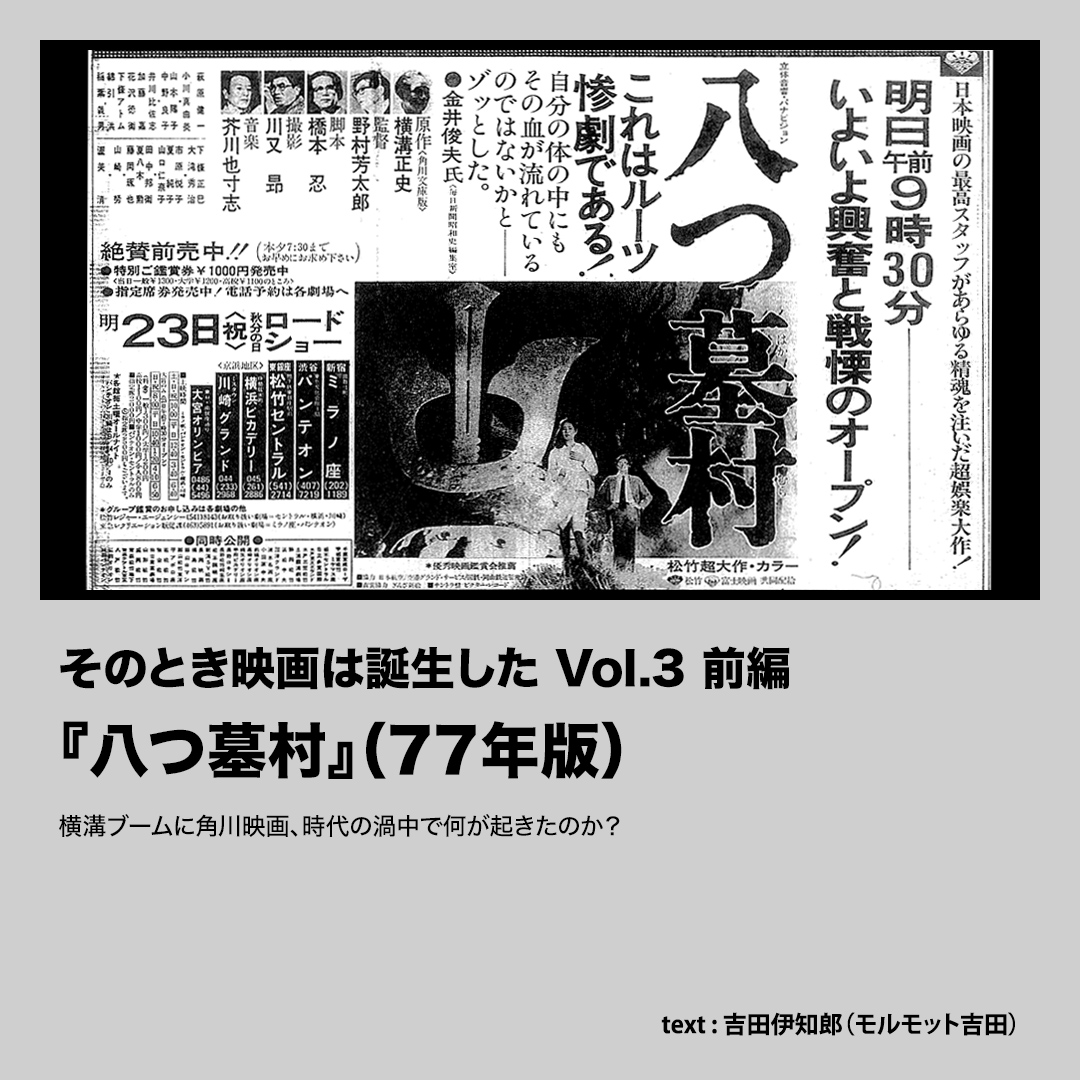
*Source (newspaper advertisement): Author's collection
``Yatsu Tomb Village'' (1977 edition) What happened in the midst of the Yokomizo boom and Kadokawa films? [That's when movies were born Vol.3 Part 1]


"Honjin Murder Case" vs. "The Village of Eight Graves"
Even if a director and scriptwriter are decided, nothing can come to fruition unless the original author gives permission for the film. According to Kobayashi Hisazo of Shochiku's planning department, who visited Yokomizo's Seijo residence to do some preliminary groundwork, "when we talked about adapting 'The Village of the Eight Graves' into a film, he was overjoyed and delighted" (The Zoo on a Rainy Day). Then, on April 2, 1975, director Nomura Yoshitaro, scriptwriter Suzuki Takayuki, Shochiku producer Sugisaki Shigemi, and Kobayashi from the planning department all visited Yokomizo's residence together and officially proposed adapting 'The Village of the Eight Graves' into a film. Nomura describes the situation as follows:
"I asked Yokomizo who he thought would be a good candidate to play Kosuke Kindaichi, and he replied that in my opinion, it would be Kiyoshi Atsumi." (Kurosawa Akira Research Journal, No. 8)
On the other hand, Yokomizo remembers what he said at that time as follows:
"When Shochiku approached me, I said, "I haven't thought about who will play Kindaichi Kosuke yet, but I think it will end up being a handsome guy. No, that's a problem, after all, a detective is just a narrator. There is another main character. Either the culprit or the victim, that will be a handsome guy. It would be a problem if there were two handsome guys. So I wanted Kindaichi to play a bad guy, and I thought it would be Atsumi Kiyoshi if you were the one." (From "Yokomizo Seishi Reader")
Just as Yokomizo thought that if he were to play Kindaichi at Shochiku, it would be Atsumi Kiyoshi, Atsumi himself also thought that this was the role for him. The following article appeared in the June 8, 1975 issue of Weekly Myojo:
"It was Atsumi Kiyoshi who began his fierce sales pitch, saying 'Please give me the role'... Though Atsumi had made a huge hit with 'Tora-san', he was troubled by the fact that he had no other decisive role to play. So he decided to explore new territory with Detective Kindaichi and became even more passionate about his strategy to acquire her."
As for why Atsumi was so keen on the role of Kindaichi, Nobuhiko Kobayashi, a writer who had a connection with Atsumi, testified, "When 'Columbo' first started, he said, 'If that kind of role is going to be played in Japan, it should be you,'" (Yokomizo Seishi Reader). As mentioned above, the revival of Kindaichi was influenced in no small way by Detective Columbo, but it's safe to say that Atsumi also saw the Japanese version of Columbo as Kindaichi.
I've gotten too far ahead of myself, so let's go back in time. Yokomizo had given his approval to adapt "The Village of the Eight Graves" into a film, but Nomura's plan at this point was to adapt Yokomizo's works into films one after another, starting with "The Village of the Eight Graves." Therefore, the plan was for Shochiku to acquire the film rights to not only "The Village of the Eight Graves," but also several other works, including "The Honjin Murder Case," "Gokumon Island," and "The Devil Comes and Plays the Flute." According to Nomura, he negotiated with Yokomizo as follows:
"I asked Yokomizo to give me all of his works, and in return I would make them into films one after another at Shochiku (omitted). Yokomizo said, "Let's go, let's give it to him, and I'll give all of his works to Nomura. However, yesterday I promised him that I would make only one film, 'Honjin Murder Case,' to ATG, so I'll make it somewhere else too, I don't mind that, so please give me all of his other works. And that's when the planning for 'The Village of the Eight Graves' began." (Kurosawa Akira Research Journal, No. 8)
Yes, just one day later, ATG (Art Theatre Guild of Japan) had acquired the film rights to "Honjin Murder Case."
Founded in 1961, ATG began with "Joanna the Nun" (61), and has since imported a succession of art films that had been difficult to sell at the box office, releasing many masterpieces such as "Last Year at Marienbad" (60), "The Solitude of the Long Distance Runner" (62), and "Such a Long Absence" (60). In 1968, the company began producing films, and made its mark in Japanese film history by realizing a First Love of cutting-edge projects that would have been impossible for major film companies to realize, despite their low budgets, such as "Death by Hanging" (68), "First Love: Inferno" (68), and "Nikudan" (68).
However, by the mid-1970s, chronic losses began to weigh on the company's operations, forcing it to change course. What was needed was not art films that would appeal to a select audience, but entertainment films - ATG-style entertainment films at that. That's when the plan for "Honjin Murder Case" came about. Based on the same original story as "The Three-Fingered Man," in which Kindaichi Kosuke first appeared on screen, the remake of this star film starring Kataoka Chiezo came to symbolize the transformation of ATG. However, the director was Takabayashi Yoichi, who had been known until then as an independent filmmaker, and this was his first foray into commercial film, a typical ATG choice.
Given this history, just as Shochiku was frustrated at being overtaken by ATG, ATG was also upset, saying, "If we had been one day later, we would have had 'Honjin...' taken" (Weekly Gendai, August 7, 1975). 1975 marked the beginning of the battle for Yokomizo's original work.
By the way, who first suggested that ATG make a movie out of "Honjin Murder Case"? There are various theories on this. Akira Nakao, who played Kindaichi in this film, revealed that he was the one who came up with the idea.
"I found the complete works of Yokomizo Seishi at a used bookstore in Takarazuka. I knew about 'The Village of the Eight Graves', but I thought I'd read them all anyway. I liked 'The Honjin Murder Case', so I took it to Kurai Kinshiro." (Eiga Himitsu, September 2014 issue)
Kinshiro Kuzui is a producer at ATG. However, Kuzui himself said, "At that time, when I went to Kinokuniya, paperbacks by Yokomizo Seishi were selling well. Moreover, all the young people were reading Yokomizo Seishi. I thought this might be interesting, and I became interested. (Omitted) I thought I should go and get the original work first, so I was introduced to someone at Kodansha, and went to Yokomizo-san's place at Seijo" (Testament Art Theater Shinjuku Culture).
Meanwhile, director Takabayashi Yoichi said that the idea was his own, saying, "I had the opportunity to meet Kuzui Kinshiro, and at that time I told him that if I were to make a film at ATG, I would like to make 'Honjin Murder Case'" ('The Universe of Soulful Cineaster Takabayashi Yoichi').
The three testimonies are all different, but perhaps each of them had their eye on Yokomizo at some point and they found a common thread. During the filming of this film, Nakao approached Takabayashi about making a film of "Inside the Storehouse," also by Yokomizo, but in which Kindaichi does not appear, and six years later, it was made into a film by Kadokawa Pictures. By the time this film was made, Takabayashi was more enthusiastic than Nakao, but it was likely the two men's shared sensibilities that led to the project coming to fruition.
The time setting of the ATG version of "Honjin Murder Case" was changed from the original 1937 to the present day, and Kindaichi was changed to a hippie style accordingly. According to Nakao, "That costume? I came up with that myself" (Weekly Heibon, October 20, 1977 issue). Of course, it would not be surprising if a third party appeared and claimed to be the creator of this costume.
The battle for Yokomizo's original work
Follow official SNS


