
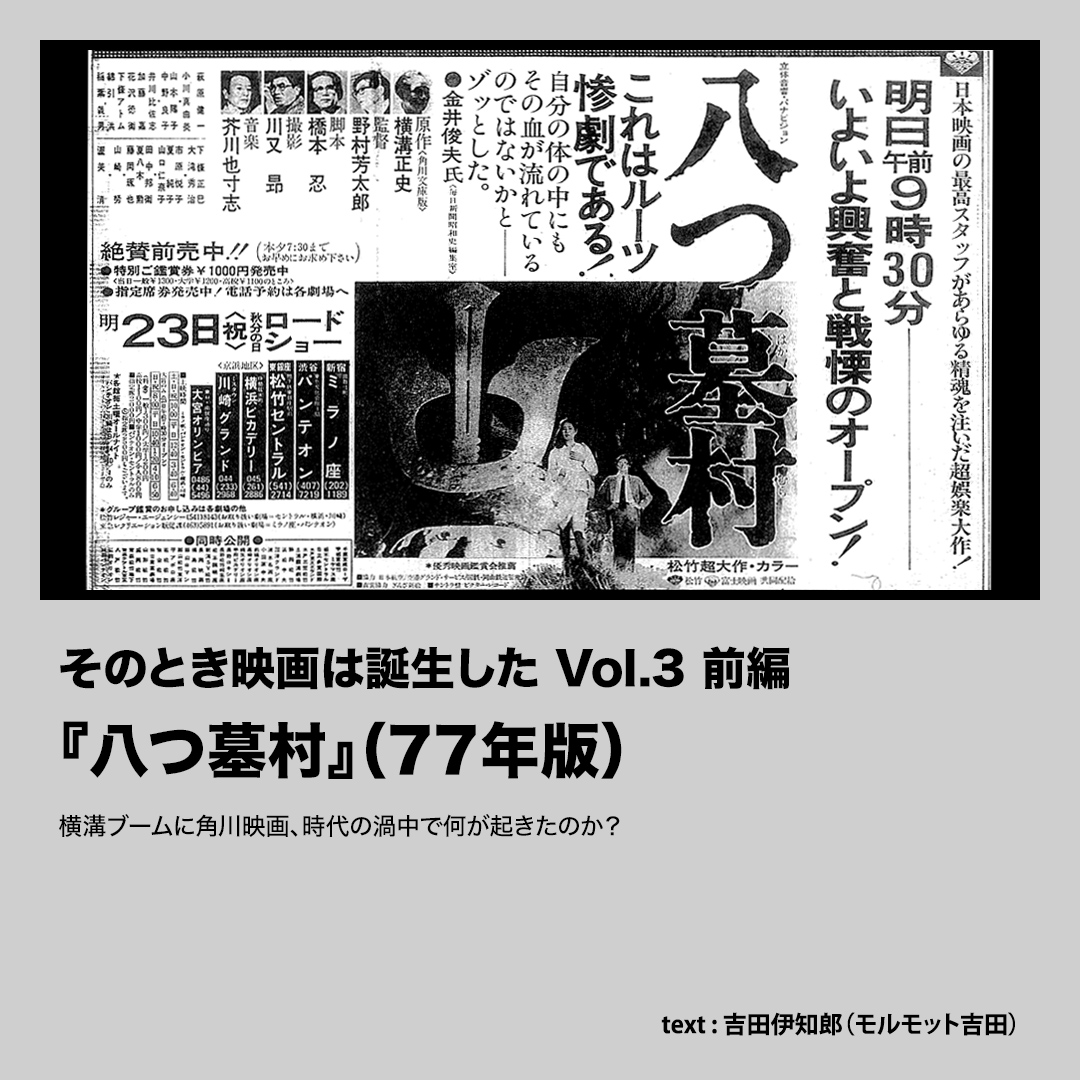
*Source (newspaper advertisement): Author's collection
``Yatsu Tomb Village'' (1977 edition) What happened in the midst of the Yokomizo boom and Kadokawa films? [That's when movies were born Vol.3 Part 1]


The battle for Yokomizo's original work
Although the film rights to "Honjin Murder Case" were acquired by ATG by just one day, Yokomizo told Shochiku that he could transfer the rights to other works. At this time, reports at the time vary on how many film rights Shochiku had acquired, so the exact number is unclear. Similar to Nomura's testimony, there are articles stating that "Shochiku has acquired the film rights to all of Yokomizo's works except for 'Honjin'" (Yomiuri Shimbun, June 9, 1975, evening edition), "Shochiku has the film rights to all of Yokomizo's works except for 'Honjin Murder Case', which was made into a film by Nippon Art Theater, and if they were to produce these works on a regular basis, it would be the birth of a new Atsumi (Kiyoshi) series" (Nikkan Sports, September 30, 1975), while other articles state that "Shochiku has bought up all the original works for 'The Village of the Eight Graves,' 'Arrow of Death,' 'Walking at Night,' 'Cross of Fire,' and 'Ghost Theatre,'" (Weekly Myojo, June 8, 1975 issue), and "Shochiku has acquired the film rights to more than ten of Yokomizo's works, and is always prepared to make a series depending on the success of 'The Village of the Eight Graves'" (Weekly Myojo, January 11, 1976 issue).
Film adaptation contracts are usually concluded with a two-year limit. If the film cannot be made within that period, the contract must be renewed or the rights must be relinquished. Yokomizo's diary entry for May 31, 1977, mentions that he received a visit from Shochiku's producer and head of production, who "requested understanding that the production of 'The Village of the Eight Graves' had exceeded the two-year limit" (The True Story of Kindaichi Kosuke), which suggests that the film adaptation contract was concluded in April or May 1975. What is of interest is whether an exclusive contract had been concluded with Shochiku, such as "Shochiku had acquired the film adaptation rights to all of Yokomizo's works."
ATG's film contract for Honjin Murder Case was signed the day before Shochiku visited Yokomizo's residence, and a press conference was held on May 8th at Toho's headquarters in Hibiya to announce its production, with Yokomizo viewing the finished product at Toho's screening room on July 9th. In producing this film, ATG partnered with Takabayashi's production company and Eizo Kyoto, a company that brings together technical staff from the former Daiei Kyoto Studios. According to Eizo Kyoto's representative and art director Nishioka Yoshinobu, Yokomizo was so satisfied with the finished product that he offered to "transfer all of the film rights to the original work free of charge" (Sunday Mainichi, February 26th, 2017). Nishioka responded to this offer as follows:
"I wondered what to do when he said that, but I would be sorry if I just said, 'Itadakimasu' and couldn't continue the film. So I replied, 'I appreciate the kind words, but this film alone is enough.'" ("This is how Monjiro, Onihei and The Inugami Family were made")
There is a sequel to this story, and two years later, Eizo Kyoto was once again working on a Kindaichi story, with a TV series produced by Mainichi Broadcasting System, and Nishioka reunited with Yokomizo. The punch line is that "The teacher told me that Kadokawa (Haruki) had taken all the filming rights, and I thought, oh no, if we had taken them all then, it would have been much better financially. I regret holding back" (ibid.). However, if this is true, Yokomizo had generously given all of the filming rights to his work to both Shochiku and Eizo Kyoto, but he may have said this to mean that he was handing over the rights first, or that he was handing over the TV adaptation rights. Either way, we will see later that oral permission from the original author can cause unexpected trouble.
In any case, Shochiku's acquisition of the film rights to several of Yokomizo's works may have had a significant impact on subsequent film adaptations. In 1975, other companies were also starting to plan Yokomizo films in addition to "Honjin Murder Case" and "The Village of the Eight Graves," and when one looks at the lineup, one notices that they were filled with unconventional works.
The first work that ATG tried to adapt after "Honjin Murder Case" was "Shinjuro." It is Yokomizo's representative work from the prewar period, published between 1936 and the following year, and depicts the brutal crimes committed by the beautiful boy Shinjuro (Kindaichi does not appear). The details of the film adaptation were told as follows in "Subarashiki Nakama" (Episode 65: Kindaichi Kosuke is still alive and well / Yokomizo Seishi, Yokomizo Takako, Ogawa Mayumi), which was broadcast on TBS on April 3, 1977.
Yokomizo: There was talk of doing "Shinjuro" at ATG. But the actor playing Shinjuro...
Ogawa: Who will be doing this?
Yokomizo: No, I had said that I wanted to do it, but it just fell through.
Ogawa: There aren't many of them. It's lovely to see the fireflies fly up and land on your cheeks like this.
Yokomizo: Please act.
The reason why Yokomizo said to Mayumi Ogawa, "Please play the role," was because Ogawa had previously stated that she wanted to play the role of Shinjuro on stage. Anyway, it turns out that ATG's "Shinjuro" was thwarted due to casting issues, but Toho was also planning another Kindaichi-related film.
The December 5, 1975 edition of Nikkan Sports reported that Toho would be adapting Yokomizo's Vampire Moth into a film. This was the first remake in 20 years, having been adapted into a film by Toho in 1956. The article cited the film's highlights as "not just entertaining in the way it solves mysteries, but also featuring the werewolf's erotic killing techniques, such as cutting off both of a girl's legs and biting off her breasts, and plenty of grotesque scenes."
A Toho official commented, "The material is so modern it's hard to believe it was made 20 years ago, so it's perfect for today's times. We want to make a spooky, spine-chilling movie." The script has already been written by director Fukuda Jun, who has worked on the "Godzilla" and "Wakadaisho" series, and the cast, including Kindaichi Kosuke, is expected to be decided in mid-December.
At this time, Toho had a "Blood-sucking Series" such as "Blood-sucking Rose" (1974), and it is likely that this film was planned as one of those horror movies. Also, although they were never made into films, two shape-shifting human films, "The Frightening Flame Man" and "The Invisible Man vs. the Flame Man," were planned around the same time, directed by Jun Fukuda and written by Masahiro Kakefuda, and "Vampire Moth" may have been seen as an extension of those.
What catches the eye is Yokomizo's "request." The article concludes, "Mr. Yokomizo wants Toho's 'Vampire Moth' to be released after Shochiku's 'The Village of Eight Graves,' so it looks like 'Vampire Moth' will be released after 'The Village of Eight Graves.'" At this point, the release of 'The Village of Eight Graves,' which was scheduled to be released in the fall of 1975, had been postponed by a year, so 'Vampire Moth' was scheduled to be released after the fall of 1976. This was probably a consideration from Yokomizo, who had told Shochiku, who was the second to apply after ATG, that he would hand over the film rights to all of his works.
However, this remake of "Vampire Moth" was never made. This can be seen as the influence of a completely new Yokomizo film project brought to Toho from outside, but more on that later. Incidentally, Jun Fukuda, who was scheduled to direct this film, was later involved in a documentary film about cultural figures in Setagaya Ward, including producing the short documentary film "Yokomizo Seishi: Writer."
When we look at them like this, we can see that in 1975, ATG produced "Honjin Murder Case" and "Shinjuro," Shochiku produced "The Village of Eight Graves," which was set in the same period as the original novel, and Toho produced "Vampire Moth," so we can see that a completely different world of Yokomizo films was unfolding before the appearance of Kadokawa films. If Shochiku had started to produce the Kindaichi series in succession, the Yokomizo films of the late 1970s would have been completely different from those we can see today.
The aforementioned Nikkan Sports article also reports that each TV station was planning a Yokomizo drama as a highlight piece in the lead-up to the spring 1976 reorganization. "The TV departments of Toei, Shochiku, and Toho flocked to Kadokawa Shoten, the contact point for the film rights to Yokomizo's works. Kadokawa was left with a headache trying to coordinate the works." In fact, Yokomizo still had a proposal for a dramatization of Immortal Butterfly for the "NTV Suspense Theater of Love" slot proposed by Daiei TV that year, which shows that applications to turn the work into a drama were already pouring in at this point. The Yokomizo boom in video had already begun in 1975.
Haruki Kadokawa and "The Village of Eight Graves"
Follow official SNS


