
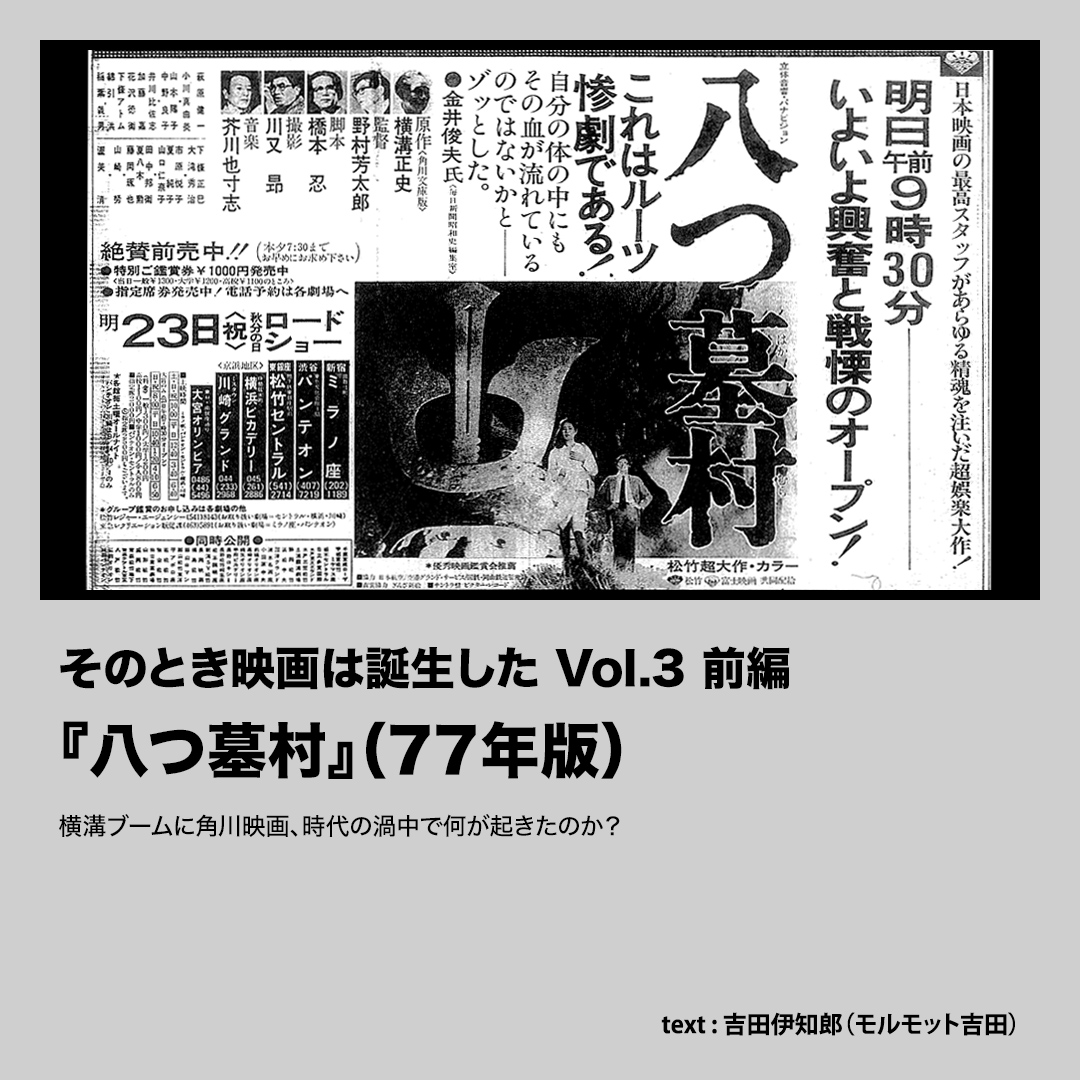
*Source (newspaper advertisement): Author's collection
``Yatsu Tomb Village'' (1977 edition) What happened in the midst of the Yokomizo boom and Kadokawa films? [That's when movies were born Vol.3 Part 1]


Haruki Kadokawa and "The Village of Eight Graves"
It is impossible to talk about Shochiku's film The Village of the Eight Graves without mentioning Kadokawa Haruki. The story goes back to late December 1970, when Haruki visited Yokomizo Seishi's house in Seijo and met him for the first time. Haruki, the eldest son of Kadokawa Genyoshi, founder of Kadokawa Shoten and president at the time, was listed as belonging to the editorial department according to the employee directory dated December 1, 1970, and was merely an editor at that time.
Shortly before that, when Haruki's sister, poet and writer Jun Henmi, who is also the author of From the Gulch with Love (22), met with Otsubo Naoyuki, former editor-in-chief of Houseki, they talked about old detective novels and Yokomizo Seishi came up on the subject. A few days later, when he mentioned it to Haruki, he said he wanted to meet Yokomizo. Since it was the end of the year, Henmi suggested early next year, but Haruki insisted that it should be within this year. According to Otsubo's testimony, "I thought that 'Yokomizo Seishi's works would definitely be a hit now,' so at the time I approached Kadokawa Haruki, gave him a list of his works, and introduced him to Yokomizo-sensei" ('Yokomizo Seishi The Way We Were'), which shows a subtle discrepancy, but it is certain that Haruki was interested in Yokomizo.
Thus, one day near the end of the year, as the winter sunshine filtered in, Haruki met Yokomizo at his residence in Seijo. Negotiations were quickly concluded to have Yatsuhakamura published by Kadokawa Bunko, and the book was published on April 26th of the following year. The publishing industry moves slowly at the start of the year. If the meeting had been scheduled for the beginning of the new year, it would have had to be the end of January or early February at the earliest. Even if editing had begun from then, it would not have been published until early summer. Haruki, who was 28 years old at the time, had a good instinct as an editor and moved him to act quickly.
Thus, starting with "The Village of the Eight Graves" (first edition of 25,000 copies), Kadokawa Bunko released "The Devil's Ball Song" (first edition of 20,000 copies) and "Gokumon Island" (first edition of 20,000 copies) in 1971, "The Devil Comes and Plays the Flute" (first edition of 25,000 copies), "The Inugami Family" (first edition of 15,000 copies), and "The Three-Headed Tower" (first edition of 30,000 copies) the following year, and "Walking at Night" (first edition of 40,000 copies) and "The Honjin Murder Case" (first edition of 30,000 copies) the year after that. "The Village of the Eight Graves" was reprinted in rapid succession with a second edition of 15,000 copies three months after its publication, and a third edition of 10,000 copies the following month, with a final circulation of 90,000 copies in 1971 alone. Five years later, at the end of December 1976, this work alone had sold a total of 1.18 million copies, which shows the magnitude of the Yokomizo boom.
Since his first meeting with Yokomizo in 1970, Haruki had been working on a series of translated paperbacks of foreign films, including Rainy Days. The year before, he had visited Furusawa Toshio of 20th Century Fox's publicity department and asked if he wanted the paperback covers to have the same design as the film posters. This led to Furusawa introducing Haruki to the publicity staff of various Foreign movies companies. It was this preparation that led Haruki to guide the original book version of Love Story, released in Japan in 1971, to success and to promote the film itself. It was during this process that Haruki discovered the potential of film and publishing. The screenplay for Love Story itself existed first, and the novelization was written during the film's production. It was published before the film's release, becoming a bestseller and providing significant advance publicity. It was a media mix that could be called the prototype of Kadokawa Pictures.
Furthermore, Haruki's father, Minamoto Yoshi, was also a publisher who was sensitive to the tie-up between film and publishing. Kadokawa Bunko, which began publication in 1949, had a lineup of works in paperback form to coincide with the release of films, such as "Little Women," "The Heiress," "The Edge of Culture," and "The Great Gatsby," in its early days, and it is easy to see his father's presence at the origin of the media mix that Haruki would later develop on a large scale. In "The Era of Kadokawa Genyoshi: How He Raised Kadokawa Shoten" (Kadokawa Shoten), the book describes Minamoto Yoshi's nose, saying, "He took the initiative to attend previews by each film company, and was also eager to obtain information at the planning stage. When he heard about a film adaptation of a work of foreign literature, he would have them research the translation rights and, if necessary, negotiate with the agent," and it reads as if he were writing about Haruki.
In 1975, Haruki, who had been promoted to senior managing director at Kadokawa Shoten, heard that Shochiku was working on adapting The Village of the Eight Graves into a film. This was a golden opportunity, as they had just been trying to combine publishing and film on a larger scale. However, apart from a foreign film distributor, Haruki had no connections to Shochiku at the time. His only contact was mystery writer Kobayashi Kyuzo, who worked in Shochiku's planning department and also contributed to Kadokawa Shoten's magazine Wild Age.
According to Kobayashi, in the fall of 1975, he was having a meeting with an editor from Kadokawa Shoten about a novel at a cafe attached to Shochiku's headquarters when the editor suddenly told him that the company's senior managing director wanted to meet him that day, leaving him perplexed. Although Kobayashi had met Haruki only once before, at the award ceremony when he had won the Rampo Prize, Kobayashi could not figure out why Haruki had come to see him.
Soon, a motorcycle pulled up in front of the cafe and Haruki got out dressed in jeans. The 33-year-old young man was full of energy and began to talk about his plan. He wanted to collaborate with Shochiku on a film adaptation of The Village of Eight Graves, and with a publishing company. He said he was thinking of doing something on a much larger scale than the traditional relationship between a film company and a publisher, which is a film and an original novel. To that end, he said he wanted to participate in promoting the film himself, and was even prepared to invest a portion of the production costs. All film companies struggle to raise funds for production. Kobayashi, who was merely a member of the planning department, decided that it was beyond his ability, and promised to arrange a meeting with Shochiku's executives in the near future.
Later, a meeting was held in the Production Department's office with Yoshiro Mishima, the head of the production department, and Yoshitoshi Masumoto, the deputy head of the planning department. It is said that Haruki suggested showing the original Kadokawa Bunko novel in the trailer for "The Village of the Eight Graves." He also asked to be added as a publicity producer, but the executives avoided giving an immediate reply.
Why the Kadokawa film version of "The Village of Eight Graves" never came to fruition
Follow official SNS


